From science fiction to a line on your transport budget
The technology has quietly crossed a threshold. In the United States, Aurora aims to have more than two hundred driverless trucks running by the end of 2026, after clocking over two hundred and fifty thousand driverless miles with no collisions blamed on its system. One of its lanes, a roughly one thousand kilometre run between Fort Worth and Phoenix, is longer than a human driver is legally allowed to cover in one stretch. Kodiak, now listed on the Nasdaq, is building out its own driverless fleet and targeting long haul launch later this year. Gatik already runs driverless delivery routes for a major retailer.
This is the shift that matters. The conversation has moved from can it work to who can put it to work first.
How to reduce the effect for your business? Please contact team Trasegro.
What driverless really means, and what it does not yet
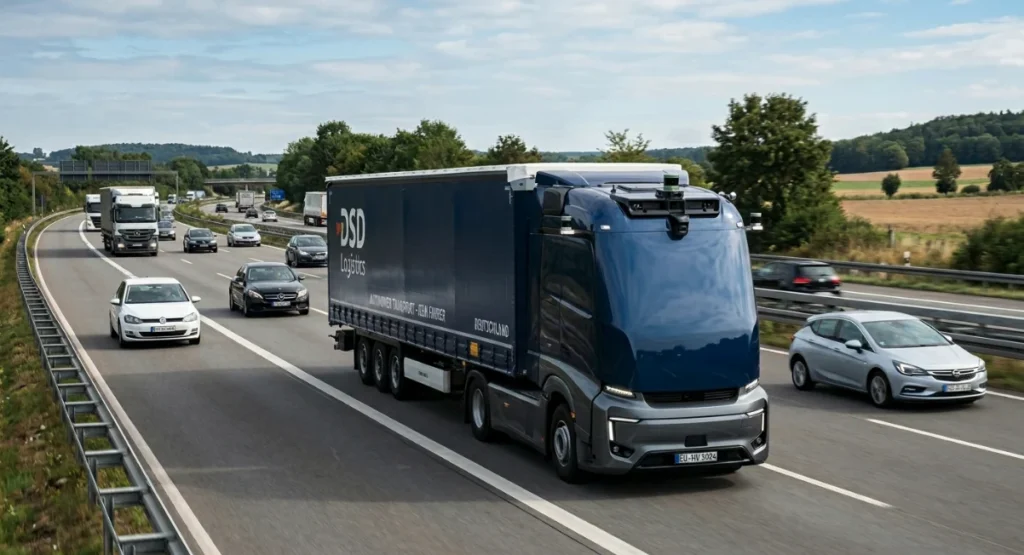
Not every autonomous truck is the same animal. Most trucks rolling off the line in 2025 and 2026 from the big European makers are very capable assistants. They steer, brake and keep their lane, but a professional still sits behind the wheel. That is a long way from a vehicle with no driver at all, which engineers call Level 4 autonomy.
The early winners are not wide open motorways in every weather. They are predictable, repeatable journeys. Think hub to hub runs between two distribution centres, fixed long haul corridors, and movements inside ports and terminals where the environment is controlled. Even in fully driverless setups, humans do not disappear. They move into remote monitoring, into the first and last mile around cities, and into oversight roles. The cab gets emptier, the control room gets busier.
The business case logistics cannot ignore
Here is why every fleet owner is paying attention, and it comes down to simple maths. A human driver is bound by hours of service rules and needs rest. A driverless truck is not, and operators expect their vehicles to run around twenty hours a day. That alone can come close to doubling the productive capacity of a single truck without buying a second one.
Add to that a structural driver shortage. Europe and North America have been short of drivers for years, and the gap is forecast to widen as the current workforce ages out. Autonomy here is less about replacing people and more about filling a hole the industry cannot recruit its way out of. Layer on falling hardware costs, with sensor kits expected to roughly halve in price, and you understand why analysts project the autonomous long haul market to grow many times over within a decade. For a shipper, the promise is steadier schedules, higher asset use and a lid on the labour costs that keep climbing.
The honest caveat. Right now this is still small. Across the entire US there are still only a few dozen genuinely driverless trucks on the road, and serious forecasts put Level 4 at only a single digit share of long haul lanes well into the 2030s. The verdienmodel is real, but it scales gradually, not overnight.
Closer to home than the headlines suggest
You do not have to look across the Atlantic. The Dutch Minister of Infrastructure has said he expects self driving buses, trucks and cars on Dutch roads on a larger scale by 2029 at the latest, and the Netherlands has already become the first country in Europe to admit certain advanced Tesla driving systems under strict conditions. The cabinet has set out plans for road pilots, new legislation and European test corridors.
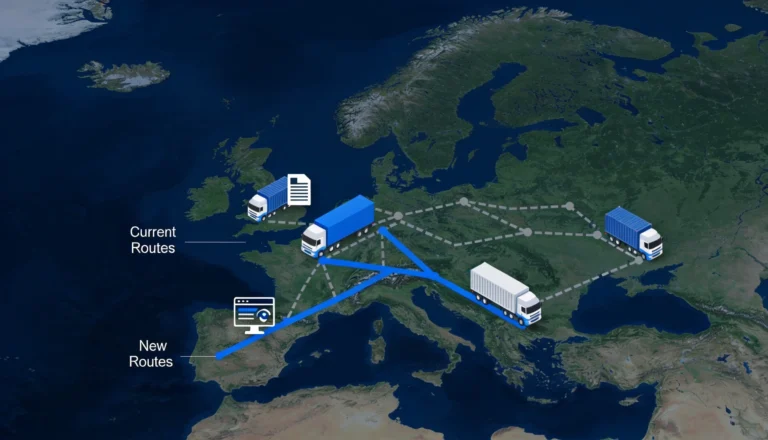
The Benelux sits right at the centre of the European effort. A Swedish operator has already demonstrated a fully autonomous heavy vehicle on public roads at the Port of Antwerp and Bruges under the Belgian framework. The EU backed MODI project has been testing automated driving along the roughly twelve hundred kilometre corridor from Rotterdam to Oslo, with Dutch truck maker DAF and others involved, studying exactly the kind of busy port and mixed traffic conditions our region is full of. Brussels has also committed to cross border test beds and to opening up type approval for hub to hub freight. The map of where this happens first runs straight through our backyard.
How to reduce the effect for your business? Please contact team Trasegro.
The real brakes: rules, liability and trust
Technology is not the hard part anymore. The hard part is everything around it.
Liability is the big unanswered question. Our traffic laws were written on the assumption that a human driver is responsible. When the vehicle drives itself, who carries the blame for an incident, the manufacturer, the software supplier, the operator or the regulator? Lawmakers are working on it, but it is not settled, and insurers are watching closely before they price these risks at scale.
Then there is the patchwork of rules. EU type approval may be harmonised, but the laws on actually deploying an autonomous truck still differ country by country, on whether a human must supervise, where the vehicle may drive and how liability is split. For cross border freight, that fragmentation is a genuine obstacle. And public trust matters too. The recent Dutch debate over the safety data behind certain self driving systems shows how quickly confidence can wobble when transparency is in doubt. One serious incident abroad can slow adoption everywhere.
What this means for your supply chain
You do not need to buy a driverless truck next quarter. You do need to factor this into your medium term planning. A few practical takeaways.
Capacity relief is coming, but unevenly. The first benefits will show up on long fixed corridors and in port and terminal movements, not on every lane. Night running becomes more interesting, since a vehicle that does not tire can move freight between hubs like Rotterdam and Antwerp outside peak hours, easing daytime congestion. And the model will be mixed for a long time, with autonomous middle miles handed off to human drivers for the complex first and last mile. The winners will be the shippers and forwarders who understand which of their flows suit automation and which do not, rather than treating it as all or nothing.
Our take
At Trasegro we are optimistic but clear eyed. For the next few years, driverless trucks are a tool that augments capacity and tackles the driver shortage, not a switch that flips overnight. The technology is ready enough, the business case is compelling, and the Benelux is one of the places it will land first. What decides whether it helps your business is preparation, knowing your lanes, your timing and your risk, and working with a partner who follows the regulation as closely as the technology. That is the difference between being surprised by change and being ready for it.
How to reduce the effect for your business? Please contact team Trasegro.
Trasegro: logistics solutions for complex requirements
With a strong focus on personal service and professionalism, Trasegro supports clients in navigating complex logistics challenges with flexible, reliable solutions.
What sets Trasegro apart is not just what we do, but how we do it. We listen, communicate and act in partnership, responding quickly when it matters most. No one-size-fits-all approach but tailored solutions that fit your reality.