Why this review is not just another Brussels update
AFIR, officially Regulation (EU) 2023/1804, has been in force since April 2024. It turned what used to be loose guidance into hard national targets for charging and refuelling infrastructure, all part of the EU’s Fit for 55 climate package. The 2026 review will decide whether those targets are ambitious enough, whether the network actually works for drivers, and whether the data behind it is transparent and standardised across borders.
That last point matters more than it sounds. The availability of a reliable charging or hydrogen corridor is what decides whether you can route a complex shipment along a lower-emission path without gambling on delays, or worse, compliance problems.
What the network already looks like
The targets are ambitious. Fast charging must cover 15 percent of the EU’s main freight network (the TEN-T network) by 2025, climbing to 50 percent in 2027 and full coverage by 2030. By then, trucks should never be more than 60 kilometres from a charger on core routes, and 100 kilometres on secondary ones. Safe parking areas are required to offer public 100 kW chargers too, starting with two per site by the end of 2027, growing to four by 2030.
Hydrogen gets its own backbone: refuelling stations no more than 200 kilometres apart, with at least one in every major city. LNG stays in the mix as well, keeping long-haul ADR trucks running during the transition rather than forcing an abrupt switch.
Where charging infrastructure meets ADR and GDP
This is the part that rarely makes headlines, but it’s exactly where the review will be felt first.
ADR, the international agreement governing the transport of dangerous goods, doesn’t care how a truck is powered, but it very much cares what that truck is carrying and where it’s allowed to stop. Hydrogen is a flammable gas, LNG a flammable liquefied gas. As electric and hydrogen trucks join the ADR fleet, carriers need to check that vehicle approvals actually match the dangerous goods class on board, and overlay ADR restrictions, tunnel bans among them, onto the new charging corridor maps. Two countries, two interpretations of the same ADR clause, is not a hypothetical.
GDP, the Good Distribution Practice guidelines for medicinal products, adds another layer. Most pharma shipments travel between 2 and 8 degrees Celsius, and every route has to be qualified and tested before it’s trusted with that cargo. Reroute a shipment onto a corridor with a different charging stop pattern, and that qualification is no longer valid. A 45-minute charging stop in the wrong place can undo months of validated route testing.
How to reduce the effect for your business? Please contact team Trasegro.
Planning for a network that’s still being built
Charging and refuelling windows are quickly becoming a planning constraint on par with loading time and mandatory driver rest. Done well, a high-power charging stop lines up neatly with a rest break. Done badly, it becomes an unplanned delay with a temperature-sensitive load sitting in the back.
A few things worth building into your planning now:
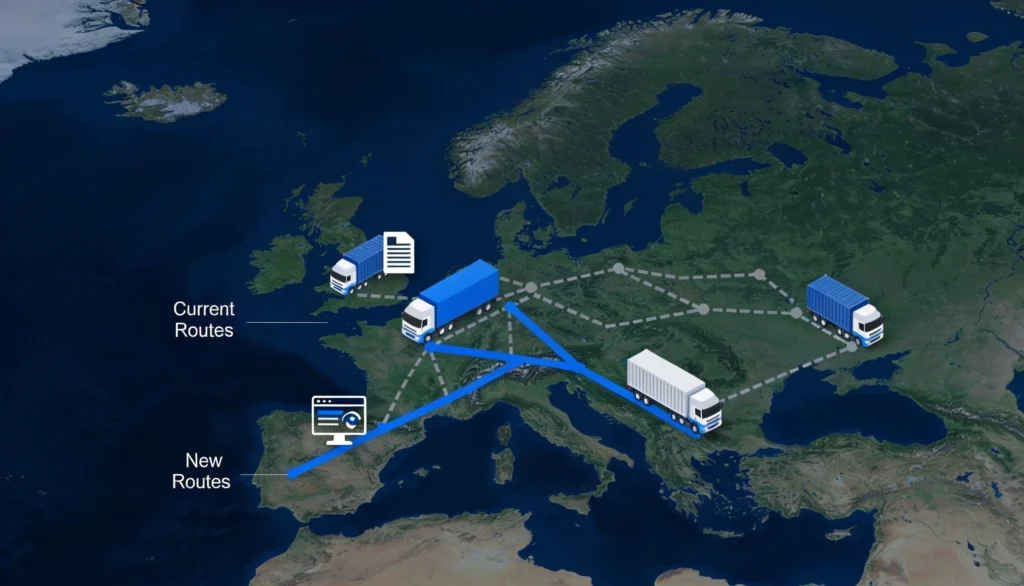
- Map your busiest routes against current and planned charging and refuelling infrastructure.
- Overlay ADR tunnel restrictions and GDP route qualifications directly onto those corridor maps, not as an afterthought.
- Feed real-time station data, hydrogen availability included, into daily operations.
- Have a contingency plan ready for outages, congestion, or a corridor that simply isn’t there yet.
The regulation itself is pushing toward more transparency here. Station operators must update static data like location within 24 hours, and live data like occupancy within a minute. Hydrogen stations have to flag when supply drops below 100 kg. From April 2026, all of it must follow the DATEX II data standard, which finally makes cross-border route planning something you can actually rely on instead of guess at.
The gap nobody’s pretending isn’t there
Even with all these targets, current projections suggest AFIR will only cover 50 to 70 percent of the public charging demand for electric trucks by 2030. Industry voices are already warning about the gap and pushing for public investment in high-power charging along the busiest corridors. Depending on how the review lands, we could see the network expand and lower-emission routing get genuinely easier, or we could see more exemptions and a patchier map that demands sharper contingency planning from everyone moving complex cargo.
How to reduce the effect for your business? Please contact team Trasegro.
Our take: don’t wait for Brussels to decide for you
Our honest advice is to start preparing now rather than wait for the review to settle anything. Get familiar with the corridors and the delegated acts behind them. Test alternative fuel route templates for your ADR and cold chain shipments through small pilot projects before you have to run them for real. And if you’re in a position to, feed what you learn back into the public consultation, because the operators on the road understand this better than anyone drafting the regulation.
At Trasegro, we treat shifts like this as an opportunity to plan smarter, not as a problem to survive. Scenario planning, dependable capacity outside the spot market, tight compliance, and one fixed point of contact, that’s how we keep complex shipments moving safely and predictably, whatever the final version of AFIR looks like.
If you want to future-proof your ADR or cold chain routes across the Benelux and the rest of Europe, get in touch or submit a transport request, and we’ll think it through with you.
Trasegro: anything except standard-logistics solutions for complex requirements With a strong focus on personal service and professionalism, Trasegro supports clients in navigating complex logistics challenges with flexible, reliable solutions.