Operational reality: more than just wait times
For freight forwarders managing complex shipments, the border controls create operational challenges that go well beyond simple delays. Documentation requirements have expanded significantly. Border officers now routinely request not only standard transport documents but also supporting materials, including letters of invitation, proof of employment for drivers, and detailed cargo manifests. For ADR shipments carrying hazardous materials, inspections can include verification of driver certifications, vehicle equipment checks, and documentation audits.
The selective nature of inspections adds further planning complexity. While most passenger vehicles receive cursory document checks, commercial vehicles face higher levels of scrutiny, particularly those carrying pharmaceutical products, chemicals, or unusual cargo configurations. This unpredictability makes it difficult to establish reliable transit schedules, forcing logistics coordinators to build substantial contingency buffers into delivery windows.
Rail freight offers partial mitigation, avoiding road based spot checks. However, infrastructure constraints limit this alternative. Border crossing segments often lack electrification, and scheduled maintenance on German routes through mid May reduces available capacity. Rerouting via the Czech Republic or Slovakia bypasses Polish controls but typically adds 8 to 12 hours to transit times, offsetting potential efficiency gains.
Understanding the legal framework behind extended controls
Poland’s authority to maintain these controls stems from the Schengen Borders Code, which permits member states to temporarily reintroduce internal border checks when facing serious threats to public policy or internal security. The Code allows initial periods of up to six months, renewable in six month increments, with a maximum duration of two years under normal circumstances. In exceptional situations, this can extend to three years with an explicit Commission recommendation.
Warsaw justifies the extension with specific data: attempted illegal entries via Lithuania tripled in 2025, while German authorities executed 314 migrant readmissions to Poland under Dublin III procedures in the first half of 2025 alone. The controls target what Polish officials describe as persistent irregular migration pressure, particularly secondary movements of third country nationals who entered the EU via Belarus and attempted westward transit through Poland.
The geopolitical dimension adds complexity. Western intelligence assessments indicate Belarus actively facilitates migrant movement as an instrument of hybrid warfare, operating in alignment with Russian strategic interests. Describing this as a security threat rather than solely a migration management issue strengthens Poland’s legal position under the Schengen framework, though it also complicates efforts at EU level to restore borderless movement.
Supply chain adaptation: from just in time to just in case
The persistence of border controls fundamentally challenges just in time supply chain models that assume frictionless EU movement. Manufacturing operations in Lower Silesia serving German customers, or German component suppliers feeding Polish production facilities, must recalibrate safety stock calculations and delivery frequencies. Industry practice is increasingly shifting toward hybrid models that maintain strategic buffer inventory for critical components, particularly those crossing Polish borders.
For pharmaceutical and food logistics operators, the stakes are particularly high. Even modest border delays can push temperature sensitive shipments outside compliance parameters, triggering costly recertification requirements. Many operators now establish staged storage nodes near border regions, enabling split shipments while maintaining cold chain integrity during extended dwell periods. This represents a clear move away from lean inventory practices toward supply chain design focused on resilience.
Technology adoption is also accelerating in response. Transport management systems that integrate real time border queue data, telematics tracking, and predictive analysis support dynamic route adjustments. Some crossing points now offer mobile applications displaying current wait times, allowing coordinators to adjust departure schedules and avoid peak congestion. While not universally available, such tools provide practical flexibility when navigating border friction.
The broader european context: a fragmenting schengen area
Poland’s extension reflects a wider pattern of internal border reactivation across Europe. Germany maintains comprehensive controls on all nine land borders through September 2026. Austria, Denmark, Norway, Sweden, and the Netherlands implement various control regimes citing migration pressure, organized crime, or infrastructure security concerns. This represents an unprecedented peacetime restriction of Schengen operations, affecting approximately one third of member states.
The cumulative impact creates structural challenges for pan European logistics networks. A shipment from Rotterdam to Warsaw might encounter controls at the Dutch German border, the German Polish border, and potentially face reciprocal Polish measures. Each inspection point adds time, documentation requirements, and uncertainty. European Parliament studies estimate these controls could cost the transport sector up to 320 million euros annually, with impacts concentrated in border regions that rely heavily on cross border operations.
The pattern appears self reinforcing. As each country extends controls citing measures taken by neighboring states, temporary exceptions risk becoming normalized policy. Poland signals reluctance to dismantle checks unilaterally while Germany maintains its controls. Germany, in turn, justifies extensions partly due to Polish border management. This reciprocal dynamic suggests that controls may persist beyond official expiration dates through rapid re notification or informal enforcement practices.
Regulatory convergence: when border controls meet compliance requirements
Polish border inspections intersect with an expanding range of transport regulations. The EU’s Next Generation Guidelines on Dangerous Goods Transport establish stricter ADR enforcement mechanisms. Border guards have explicit authority to conduct high risk inspections, verifying driver certifications, documentation compliance, and vehicle equipment standards. A detention for ADR deficiencies during a border inspection can result in vehicle impoundment and substantial penalties.
Emission standards add another layer. Germany’s nationwide Clean Transport Zone restricts vehicles that fail to meet Euro 6 diesel or Euro 4 gasoline standards. Poland’s new Krakow Clean Transport Zone applies similar restrictions. These requirements reduce the pool of compliant vehicles available for cross border operations, tightening capacity at the same time that border delays increase equipment use.
The Entry and Exit System, fully operational since April 2026, introduces biometric processing at Polish borders. While it primarily affects passenger traffic, the system creates spillover delays when passenger and freight flows converge at crossing points. For companies relocating staff or technical specialists across borders, processing under this system can add hours to journey times during peak periods.
Strategic mitigation: building resilience into cross border operations
Successful navigation of the 2026 border environment requires a multifaceted response. Clear and complete documentation is essential. Companies must ensure all drivers carry comprehensive paperwork beyond basic transport documents, including employment verification, proof of the purpose of the journey, and any special permits required for specific cargo types. For regulated shipments, this includes maintaining up to date GDP certificates, temperature logs, ADR documentation, and detailed commercial invoices that are readily accessible for inspection.
Trusted trader programs offer meaningful advantages. Authorized Economic Operator, AEO, certification provides priority treatment at border crossings and reduces inspection rates. Although it requires thorough audits and sustained compliance efforts, AEO status improves predictability through advance inspection notices and designated control locations. For high volume operators, the investment can quickly pay off through fewer delays and simpler procedures.
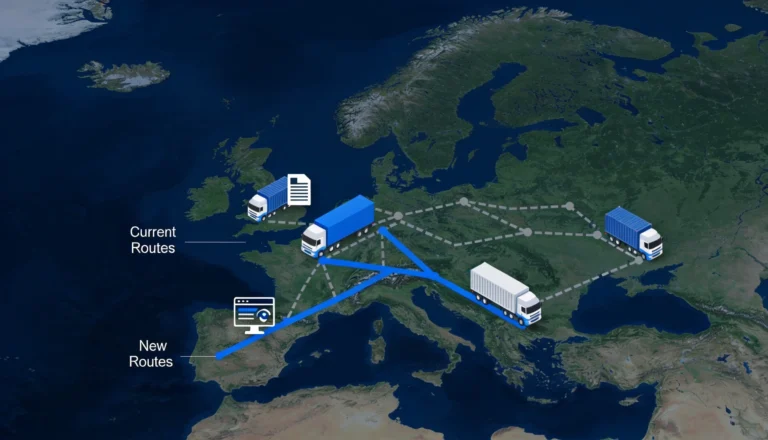
Route diversification becomes a strategic decision rather than a purely tactical one. Building relationships with rail operators, exploring intermodal options, and mapping alternative routes via Czech or Slovak borders provide flexibility when primary corridors are congested. While these alternatives often increase standard transit times, they offer reliability that may outweigh efficiency losses for critical shipments.
Clear communication with customers is equally important. Setting realistic expectations about border related delays, building appropriate buffer times into service agreements, and providing real time shipment visibility help maintain trust during disruptions. For specialized freight forwarders that focus on complex shipments, the ability to manage border challenges while maintaining compliance becomes a clear competitive advantage.
Looking forward: scenarios for late 2026 and beyond
The October 2026 expiration date should be viewed as a decision point rather than a certainty. Poland explicitly links the possible lifting of controls to the successful implementation of the EU’s Pact on Migration and Asylum, scheduled for deployment in late 2026. If the Pact is delayed, which is common with complex EU legislation that requires national infrastructure and coordination, Poland may cite this as justification for further extensions.
The political outlook suggests caution in assuming rapid normalization. While Prime Minister Tusk’s government presents the controls as a temporary necessity rather than a permanent policy, domestic political pressures and the precedent of repeated extensions across several member states create momentum toward continuation. The combination of migration concerns, security narratives involving Belarus and Russia, and the operational adjustments already made by transport operators reduces the political cost of maintaining controls.
For logistics professionals, this uncertainty requires continued investment in border management capabilities through 2027 planning cycles. The operational adjustments introduced in response to current controls, from improved documentation systems to route flexibility and inventory buffers, strengthen supply chain resilience regardless of future border policy decisions. In a period marked by geopolitical volatility and frequent supply chain disruption, such investments in operational flexibility deliver value beyond the immediate challenge of navigating Polish border controls.
The transformation of Polish borders from seamless transit points into managed checkpoints reflects broader shifts in European integration and global supply chain assumptions. While this development adds complexity and cost, it also creates opportunities for logistics providers that can deliver predictability, strong compliance standards, and transparent communication in an uncertain environment. For operators handling complex, time critical shipments where reliability is essential, the ability to manage this new reality while maintaining service quality becomes a strong market advantage. Success depends on treating border controls not as a temporary inconvenience but as structural conditions that require thoughtful, long term adaptation.
Trasegro: logistics solutions for complex requirements
With a strong focus on personal service and professionalism, Trasegro supports clients in navigating complex logistics challenges with flexible, reliable solutions.