How disruptive is this for ADR transport, really?
The numbers tell the story. During the Polish farmer blockades of February 2024, logistics companies reported average delays of 12 to 18 hours per shipment, with fuel and labour costs climbing 15 to 20 percent because of detours and extra driving hours. French protests in early 2024 shut down highways between Marseille and Lyon and damaged toll infrastructure. An earlier blockade at the Polish-Ukrainian border left roughly 20,000 vehicles stranded over two days, including around 1,700 trucks.
And it isn’t slowing down. Serbian transport associations have already announced nationwide blockades at key EU border freight terminals, starting in April 2026.
What’s actually happening on Europe’s roads
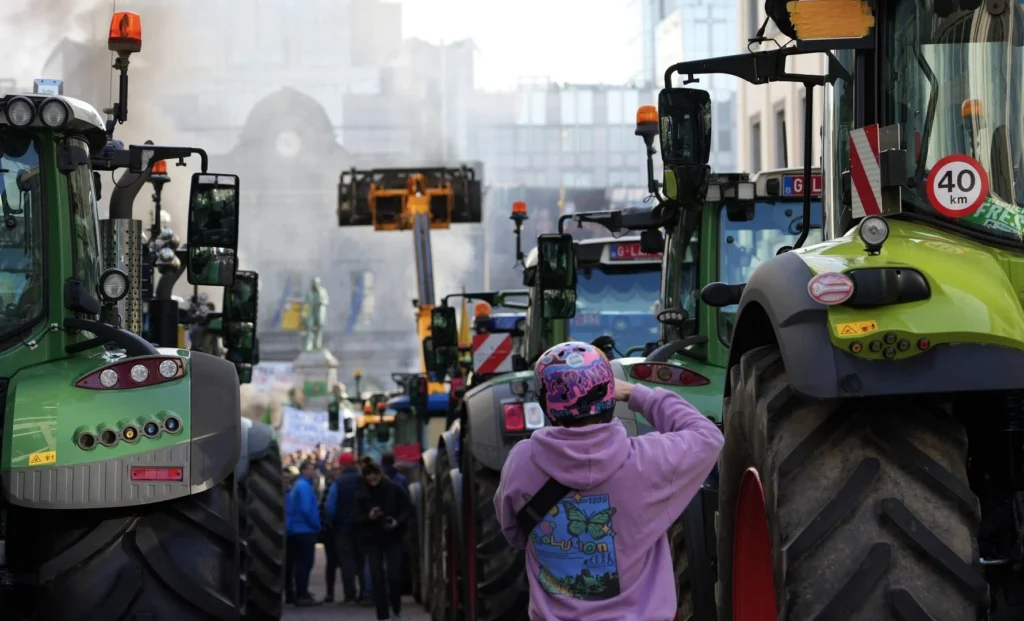
Farmer protests have swept through at least eleven EU countries since 2023, including Belgium, France, Germany, Poland, the Netherlands and Romania. Tractors, trucks and burning hay bales have shut down major highways, toll booths and border crossings.
The grievances behind the protests run deep: low sale prices, rising input and energy costs, heavy regulation, retailer power, mounting debt and competition from cheap imports such as Ukrainian grain.
It’s tempting to read this as a simple revolt against climate rules. That framing misses the point. These protests are rooted in structural, economic pressure, and that means they won’t disappear just because one policy gets softened. For anyone planning transport, that’s the real takeaway: blocked roads aren’t a one-off. They’re a recurring risk you need to plan around.
Why ADR transport and food shipments feel it the hardest
Time-critical dangerous goods and perishable food share one weak spot: neither can absorb long delays without real consequences.
For ADR cargo, hours stuck in traffic can mean hazardous goods sitting in unsecured locations, without the supervision or facilities the regulations require. A significant detour can also mean updated transport documentation, just to keep everything traceable and compliant.
For food and pharmaceuticals, the enemy is temperature. Perishable products often travel within narrow temperature windows, and a blockade can tip a shipment straight into spoilage or a temperature excursion. Under Good Distribution Practice (GDP) guidelines, wholesale distributors are required to protect medicinal products from breakage and theft, and to keep temperatures within validated limits for the entire journey. Every extra hour stuck behind a line of tractors is another hour your monitoring systems have to get absolutely right.
How to reduce the effect for your business? Please contact team Trasegro to build a route plan that actually holds up.
Resilience doesn’t come from hoping the roads stay open. It comes from building disruption into your planning from day one. Here’s an approach that works for complex, sensitive shipments.
- Map the rules before you map the route. Start by matching every cargo type to its regulatory requirements, whether that’s ADR packaging and vehicle controls or GDP-validated temperature systems and calibrated monitoring. This tells you exactly which corridors, crossings and facilities you can’t do without.
- Assess risk by scenario, not by hope. Look at where protests have repeatedly flared up, such as the E30 corridor between Berlin and Eastern Europe, and treat those stretches as high-risk during sensitive periods. Translate each scenario into realistic delay ranges, cost impact and compliance consequences, so you’re comparing route options on reliability, not just price.
- Design redundancy, not a single “best” route. Rather than betting everything on one optimal route, plan a primary and a secondary corridor that both still meet ADR and GDP requirements. Where it makes sense, consider intermodal alternatives such as rail or inland waterways when road risk is high, as long as the dangerous goods rules for those modes are fully covered.
- Run everything through a control tower. A road control tower gives you a live overview of your transport flows, pulling together carrier data, vehicle tracking, traffic information and protest alerts in one place. For dangerous goods and temperature-sensitive cargo, this is your command centre: it lets you spot a blockade forming early, reroute fast and properly document any deviation. It also helps you track which modes you’re using and how much CO2 you’re emitting, which feeds straight into your sustainability reporting.
- Work with partners who can actually deliver. The best contingency plan is worthless if no carrier can act on it under pressure. Fixed, trusted partners with the right capacity and training can pre-position vehicles on alternative routes and build buffer time into their schedules. This is exactly where an independent freight forwarder earns its keep, coordinating road, sea and air through a single point of contact.
A tighter rulebook
While the roads get less predictable, the compliance environment is getting stricter, not looser. ADR 2025 became applicable on 1 January 2025 and mandatory under national rules from 1 July 2025, bringing several changes worth knowing:
- Classification code M4 now covers both lithium-ion and sodium-ion batteries.
- New provisions govern waste paints, mixed waste streams and asbestos-contaminated materials.
- Vehicles running on electrical energy sources now need clearly marked de-energising controls, both near the source and in the cab.
Within the EU, Directive 2008/68/EC keeps road, rail and inland waterway transport of dangerous goods aligned with international agreements. Add rising costs on top, such as Germany’s CO2 truck toll, which can push road charges up by as much as 83 percent, and the message is clear: there’s no room to cut corners.
At Trasegro, we plan complex, compliant transport across the Benelux, Europe and beyond, combining reliable capacity outside the spot market with strong compliance and clear control tower visibility. If road blockades keep putting your ADR or food deliveries at risk, get in touch or submit a transport request, and we’ll help you build a plan B before you need one.
Trasegro: logistics solutions for complex requirements
With a strong focus on personal service and professionalism, Trasegro supports clients in navigating complex logistics challenges with flexible, reliable solutions.